William Shakespeare’s signature
Shakespeare wrote dozens of plays, yet the only writing that everyone agrees is in his own hand is six signatures on legal papers. They are cramped, wobbly and spelled differently every time. Watch one of them being drawn below and see what a quill signature from 1612 looks like up close.
Secretary hand, the joined-up script taught in Tudor schools, with delicate upstrokes at the start of letters and an unusual curled "k".
Only on legal documents: a court deposition, a house purchase and mortgage in Blackfriars, and the three pages of his will.
Quick and compressed. The Blackfriars signatures were squeezed into the narrow gap beside the seal tag.
Low to medium. Several versions are abbreviated, such as "Willm Shakp", and the last ones on the will are shaky.
Six signatures, four documents
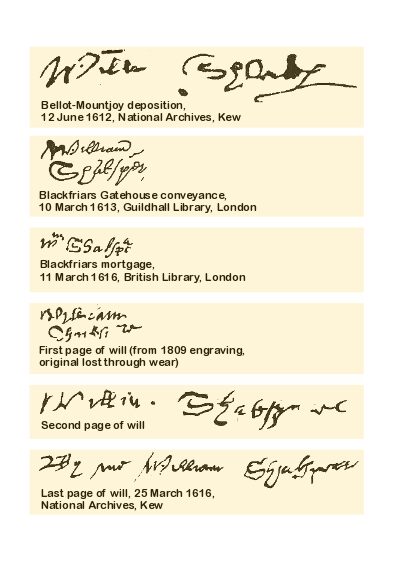
The signatures that scholars accept as genuine sit on four documents. One is a deposition in the Bellott v Mountjoy lawsuit, dated 11 May 1612. Two are on the purchase and the mortgage of a house in Blackfriars, London, dated 10 and 11 March 1613. The last three are on the pages of his will, signed on 25 March 1616, about a month before he died. No letter or diary in his handwriting survives, and the plays are not in a hand that everyone accepts as his, which is why these six small scrawls matter so much to historians.
Never spelled the same way twice
The six signatures read "Willm Shakp", "William Shakspēr", "Wm Shakspē", "William Shakspere", "Willm Shakspere" and "By me William Shakspeare". Three of them are abbreviated using shorthand marks that clerks and merchants used all the time. Spelling was not fixed in Elizabethan England, so writing a name differently on different days was perfectly normal. For a modern reader the surprise is that the most famous writer in English never settled on one form of his name.
The signature in the wild
Create your Professional Signature in 5 minutes
Not a font: a signature designed for your name, in several drafts, with a practice sheet so you can write it by hand.
A quill, a squeezed space and a tired hand
Shakespeare wrote with a quill in secretary hand, the everyday cursive of his time. The Blackfriars signatures were pushed into the narrow strip of parchment left beside the seal tag, which explains their tight, compressed look. On the will, the penmanship gets visibly worse from page to page, and some people read that as a sign of illness. The paleographer Edward Maunde Thompson also noticed the neat introductory upstrokes, which suggested a trained scribe’s habits, not a beginner’s.
What you can learn from it
The lesson from Shakespeare’s signatures is that a signature does not need to be spelled in full to be yours. Three of his six are shortened, and each one was still accepted as a binding signature on a legal document. What counts is that you write the same recognisable shape, with the same rhythm, each time you sign. If you want a version with a clear first letter and a confident ending, a Professional Signature designed by us comes with a practice sheet so you can make it your own.
Sources
- Wikipedia: Shakespeare’s handwriting
- Wikipedia: William Shakespeare (will of 25 March 1616)
- Wikimedia Commons: the six known signatures
Editorial content. We are not affiliated with the people shown. We do not create copies of other people’s signatures, and signing someone else’s name is forgery.