Jensen Huang’s signature
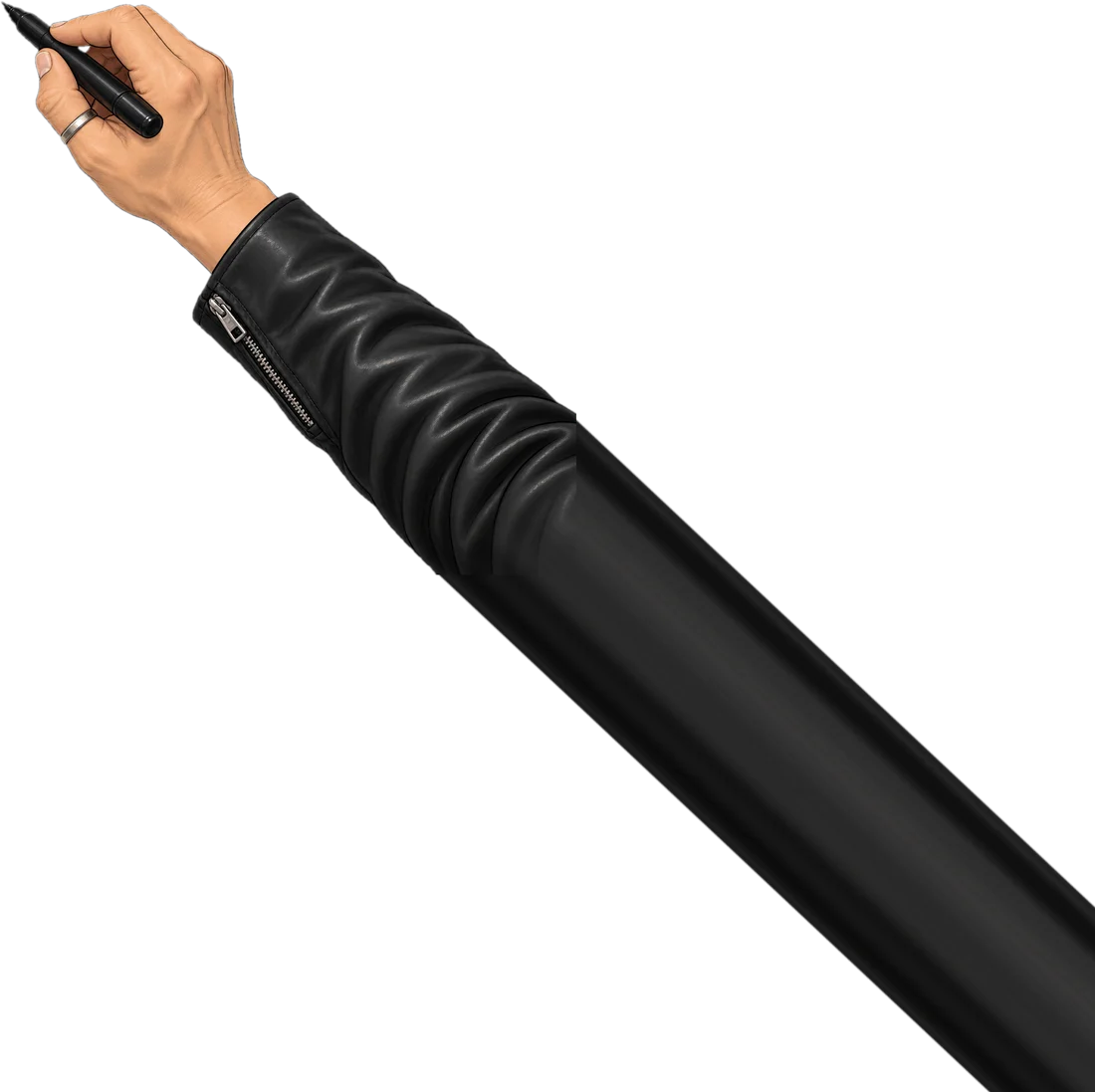
Jensen Huang co-founded Nvidia in 1993 and led it as chief executive for more than three decades, until November 2026. His signature turns up on graphics cards, on the first AI supercomputer Nvidia gave away and on countless items fans hold out to him at trade shows. Watch it being drawn below, then read what makes it so quick to write.
What’s notable
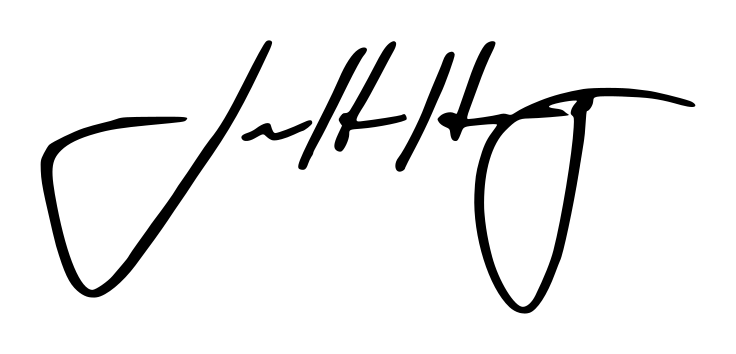
- Only two letters carry the whole signature: a sweeping J and a wide H.
- One steep diagonal out of the J sets a strong forward slant for everything after it.
- The letters between the capitals shrink to a handful of short, parallel strokes.
- The H ends in a loop that drops far below the line and runs out to the right.
- Almost every stroke is straight, so the whole name is written in about a second.
Signature profile
Legibility
1/5Only the J and the H can be read. Everything in between is a row of slanted ticks, so the name works as a mark rather than as text.
Speed
5/5Straight strokes, no loops in the middle and no dots to add afterwards. He can sign one item after the next without slowing down.
Flourish
3/5Two big loops, under the J and under the H, give it drama. Beyond that there is no decoration: no underline, no extra swirl.
Size
4/5Wide and flat. Both loops reach far below the line, so it fills a badge or a graphics card shroud without looking cramped.
Connected strokes
2/5The pen lifts several times. The J stands on its own, the ticks are separate strokes, and only the H runs into its loop and the final stroke.
Our editorial assessment of the shape, not a handwriting analysis of the person.
We design one for your name, fast to write and easy to recognise.
The signature in detail
1First letter
The J opens with a short bar to the left, falls into a deep loop and leaves it in one long diagonal. That single stroke is the tallest part of the signature and the one people recognise.
2Middle
Where “ensen” and “Hu” would be, there are only short slanted ticks of almost equal height. They keep the rhythm going without spelling anything out.
3Last letter
The H is drawn wide and open. Its loop swings well below the baseline and the final stroke runs out to the right, which gives the signature a clear end.
4Slant
Strongly forward, set by the diagonal out of the J. The angle stays almost the same from the first stroke to the last.
5Baseline
It rises slightly from left to right. Only the loops of the J and the H dip below it.
6Pen and size
The versions on hardware and badges are mostly written with a thick marker, so lines are even and bold. The signature is wide and flat rather than tall.
7Speed
Very high. Straight strokes, few loops and no dotted letters mean almost no pauses, which suits someone who signs hundreds of items in a row.
Who is Jensen Huang?
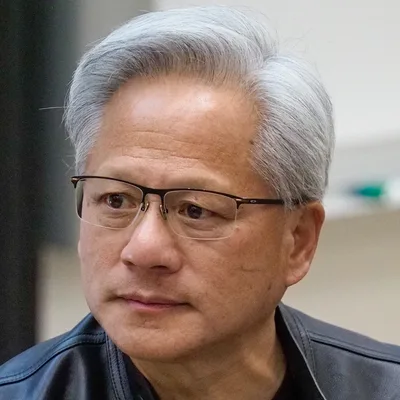
Jensen Huang was born in Tainan, Taiwan, in 1963 and moved to the United States as a child. He studied electrical engineering at Oregon State University and Stanford, worked on chips at LSI Logic and AMD and co-founded Nvidia in 1993.
Under his lead the company went from graphics cards for gamers to the chips behind most of today’s AI systems. He stepped down as chief executive in November 2026.
- Born
- 1963, Tainan, Taiwan
- Known for
- Co-founding and leading Nvidia
- Chief executive
- 1993 until November 2026
- Trademark
- Black leather jacket
Photo: Anders Eidesvik via Wikimedia Commons, CC BY-SA 4.0, source
Two big letters, very little in between
The signature lives from its two capitals. The J begins with a bar to the left, falls into a big loop and rises in one steep diagonal that sets the slant for everything after it.
The rest of the first name becomes a few short, parallel strokes. The H at the end is drawn wide, with a loop that swings far below the line and a stroke that runs out to the right.
The order in the animation is our reconstruction from the finished signature, not a recording.
A founder who signs hardware
Nvidia was planned at a Denny’s restaurant in East San Jose in 1993 by Huang, Chris Malachowsky and Curtis Priem. Decades later its chief executive signs the machines himself.
In August 2016 he delivered the first DGX-1 AI system to OpenAI and wrote on it: “To Elon and the OpenAI Team! To the future of computing and humanity. I present you the world’s first DGX-1!” In April 2024 he did the same with the first DGX H200, and in October 2025 with a DGX Spark for SpaceX.
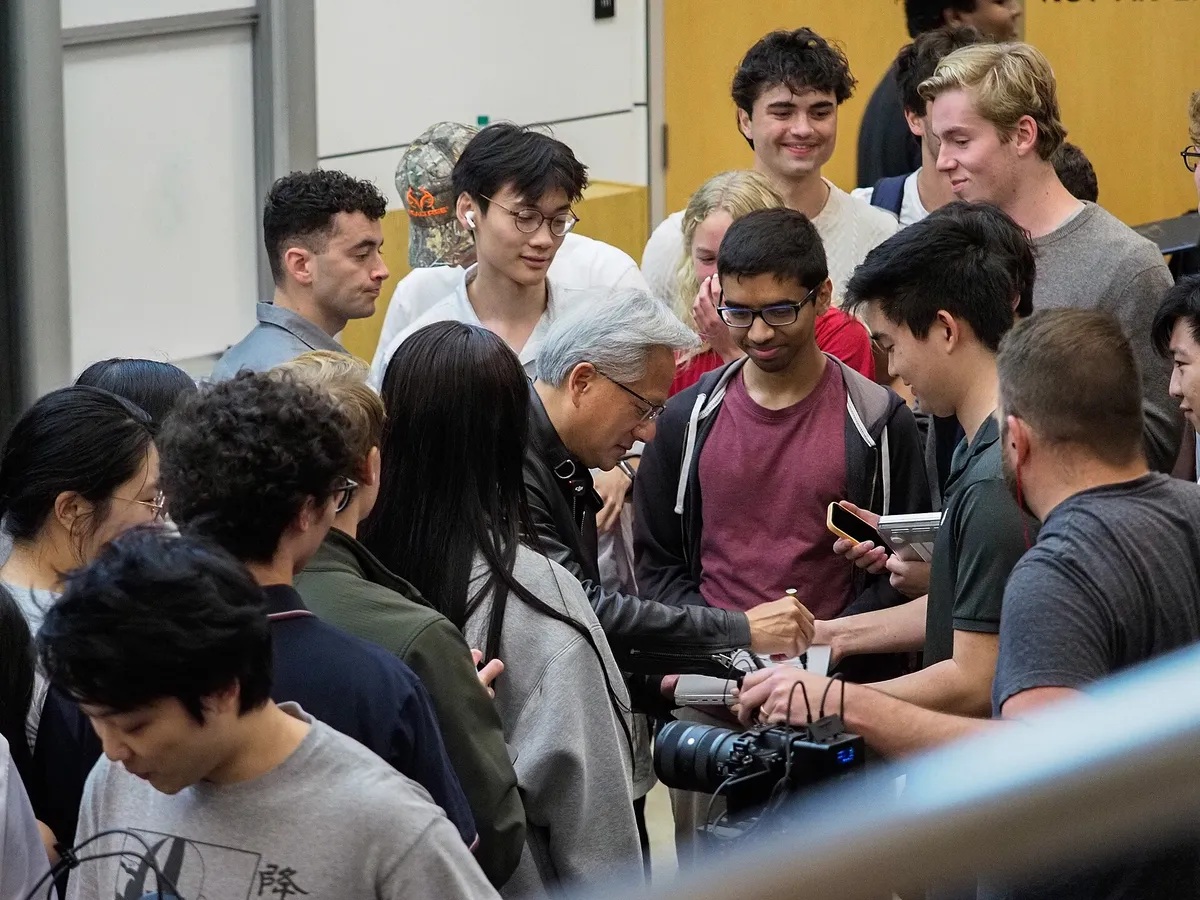
At conferences he signs graphics cards that are given away, such as RTX 3090 Ti cards at GTC in September 2022. At Computex 2024 he stopped at a partner booth to sign a graphics card there.
Watch Jensen Huang sign
The signature in the wild
A signature as distinctive as this, designed for your name
Not a font: a signature designed for your name, in several drafts, with a practice sheet so you can write it by hand.
What is Jensen Huang’s autograph worth?
More than most CEOs’ autographs, by a long way. Huang signs hardware rather than photos, and the object matters as much as the ink: a signed graphics card is a piece of tech history and a collector’s item in one. These are the cases with public figures:
- Leather jacket: a black leather jacket he signed, his trademark look, sold at Sotheby’s for 960,000 dollars. The estimate was 40,000 to 60,000.
- RTX Pro 6000: a card he signed twice in gold ink, won in a raffle at GTC 2026, went for 57,450 dollars at RR Auction in August 2026.
- Golden RTX 5090: an ASUS ROG Astral card plated in gold was shown at GTC 2025 with his autograph on it.
- Giveaway cards: at GTC in September 2022 Nvidia handed out RTX 3090 Ti cards he had signed. These come up for sale now and then and are the most realistic way to own his signature.
For a buyer, the story counts as much as the strokes. His signature is quick to imitate, so value comes from proof: a photo or video of the signing, the event badge, the raffle ticket, an auction house certificate. A card without that record is, in the end, a card with a marker line on it.
What you can learn from it
A busy person signs hundreds of items in a row, so the signature has to be fast. Huang’s keeps two strong capitals and lets the rest run together in straight strokes.
That is a good model for anyone who signs often: pick one or two letters that carry the shape and keep the rest simple. When we design a Professional Signature we look for exactly that kind of balance.
Questions about Jensen Huang’s signature
What does Jensen Huang’s signature look like?
A large J with a deep loop and a long diagonal, a few short slanted strokes, and a wide H whose loop drops below the line and runs out to the right.
Can you read his signature?
Only the J and the H. The letters in between are reduced to short marks, which is common for people who sign a lot.
Where has he signed things?
On graphics cards and computers given to partners and attendees, on the first DGX-1 system delivered to OpenAI in 2016, and on items fans bring to trade shows.
Can I use his signature as mine?
No. Copying someone else’s signature is forgery. You can get a signature with a similar clear gesture designed for your own name instead.
Now make your own
You cannot copy a famous signature, but you can get one with the same clear gesture.
Several drafts designed for your name, with a practice sheet to learn it by hand.
Get started
Sources (13)
- Wikipedia: Jensen Huang
- Nvidia filing with the SEC on the CEO transition, November 2026
- Wikimedia Commons: Jensen Huang signature
- Fortune: Nvidia delivers the first DGX-1 to OpenAI, August 2016
- Tom’s Hardware: first DGX H200 hand-delivered to OpenAI, April 2024
- NVIDIA on YouTube: DGX Spark arrives at SpaceX, October 2025
- Wccftech: signed RTX 3090 Ti giveaway at GTC 2022
- Wccftech: graphics card signed at Computex 2024
- Tom’s Hardware: signed golden RTX 5090 at GTC 2025
- Pause Hardware: signed RTX Pro 6000 sold at RR Auction, 2026
- Players: signed leather jacket sold at Sotheby’s
- Fortune: who is Jensen Huang?
- Wikimedia Commons: portrait and Stanford photos by Anders Eidesvik
Editorial content. We are not affiliated with the people shown. We do not create copies of other people’s signatures, and signing someone else’s name is forgery.